
10 Payroll Mistakes Small Business Owners Must Avoid
Payroll mistakes can cost small businesses thousands in fines, lost time, and employee trust. Nearly 40% of small businesses face annual penalties averaging $850 due to payroll tax errors. Each mistake can cost $291 in administrative fixes. From misclassifying employees to missing tax deadlines, these errors can lead to legal trouble, financial losses, and high employee turnover.
Here’s a quick rundown of the most common payroll mistakes and how to avoid them:
- Misclassifying workers: Mislabeling employees as contractors can result in unpaid taxes and penalties.
- Missing tax deadlines: Late payments can lead to fines up to 15%.
- Overtime miscalculations: Errors in overtime pay often result in back wages and disputes.
- Outdated tax withholding: Using old tax tables can create paycheck discrepancies.
- Ignoring state/local taxes: Remote work complicates compliance with varying rates and laws.
- Inaccurate time tracking: Missing hours or manual errors can lead to underpayment.
- Deduction errors: Mistakes in garnishments or benefits withholding can lead to compliance issues.
- Minimum wage violations: Failing to meet local wage laws can result in back pay and fines.
- Late payroll processing: Delayed paychecks hurt employee trust and invite penalties.
- Poor record-keeping: Missing or disorganized records can lead to disputes and audits.
Avoiding these mistakes involves staying informed on laws, automating processes, and maintaining accurate records. Payroll errors are preventable, and proactive management can save money and maintain employee trust.
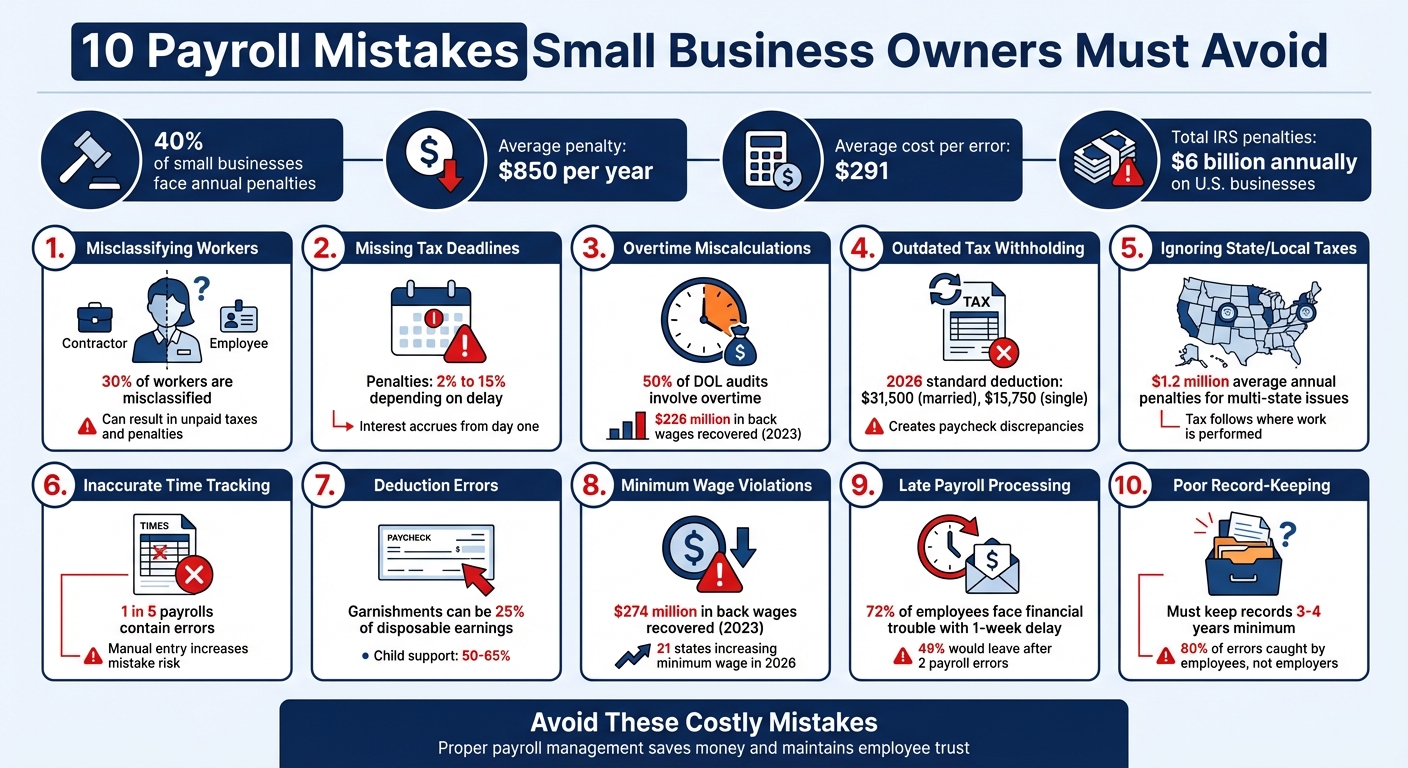
10 Common Payroll Mistakes Small Businesses Must Avoid
Biggest payroll mistakes for small businesses to avoid
1. Misclassifying Employees as Independent Contractors
Misclassifying employees as independent contractors can lead to hefty legal and financial consequences. It’s estimated that nearly 30% of workers fall into this category of misclassification, and the fallout can be severe.
To determine whether a worker is an employee or an independent contractor, the IRS uses the Common Law Control Test, which evaluates behavioral, financial, and relational factors. Meanwhile, the Department of Labor relies on the Economic Reality Test under the FLSA to assess the worker's status.
"What matters is that the business has the right to control the details of how the worker's services are performed." – IRS
The penalties for getting this wrong can be staggering. Employers may owe unpaid payroll taxes like FICA, FUTA, and SUTA, face liquidated damages under the FLSA (which can double the liability), and even risk personal liability under the Trust Fund Recovery Penalty.
If you’re uncertain about a worker’s classification, filing IRS Form SS-8 can provide an official determination. Additionally, always collect Form W-9 from contractors to obtain their Taxpayer Identification Number. However, be aware that states like California apply stricter standards, such as the "ABC test". A signed agreement alone won’t protect you - regulators will examine the actual degree of control and the economic reality of the relationship.
Up next, let’s dive into another common payroll pitfall: missing critical tax deadlines.
2. Missing Payroll Tax Deadlines and Deposits
Missing a payroll tax deadline can hit your business hard, both financially and reputationally. Did you know that 40% of small businesses face fines every year due to payroll tax mistakes? On average, these IRS penalties amount to $850 annually. Add to that the $291 average cost of fixing just one payroll error - thanks to expedited processing and extra administrative work - and the expenses quickly pile up. Staying on top of deadlines isn’t just about avoiding fines; it’s about safeguarding your finances and maintaining your employees’ trust.
The IRS imposes penalties starting at 2% for payments that are just a few days late. If payments remain outstanding for over 10 days after receiving a notice, the penalty can climb to 15%. On top of that, interest begins accruing from the very first day and keeps going until the balance is fully paid. And let’s not forget state penalties. For instance, California charges 15% of the unpaid tax, while Florida levies the greater of $50 or 10% of the tax owed, with a cap of $300.
Your deposit schedule is determined by your 12-month lookback period. Here’s how it works:
- Monthly Depositors: If your total tax liability during the lookback period (ending the previous June 30) is $50,000 or less, you must deposit taxes by the 15th of the following month.
- Semi-weekly Depositors: If your liability exceeds $50,000, deposits are due based on your pay period. For paydays from Wednesday to Friday, deposits are due the following Wednesday. For Saturday-to-Tuesday paydays, they’re due the following Friday.
- Next-Day Depositors: Accumulate $100,000 or more in taxes on any single day, and you’re required to deposit by the next business day, no exceptions.
To avoid penalties, submit all federal tax deposits via EFTPS by 8:00 PM Eastern Time one calendar day before the due date. If you miss this EFTPS deadline, you can still make same-day wire payments through the Federal Tax Collection Service (FTCS) to minimize penalties. A smart move? Set aside withheld taxes in a separate bank account to ensure they’re not accidentally used for other operational expenses. Misusing these funds could lead to personal liability under the Trust Fund Recovery Penalty.
"For employers that mail their returns, the IRS considers payroll filings on time as long as they have the appropriate postage, are postmarked, and are mailed by the filing due date." – Sandra Akins, Certified Payroll Professional (CPP)
To stay organized, create a compliance calendar with all key federal and state deadlines. Keep in mind that filing extensions only give you more time to file, not to pay. Some important 2026 dates include February 2 for W-2s and Form 940, April 30 for Q1 Form 941, July 31 for Q2, and November 2 for Q3.
Next, let’s dive into another common payroll error that can impact accuracy.
3. Incorrectly Calculating Overtime Pay
Mistakes in calculating overtime are one of the most frequent payroll errors. In fact, overtime-related issues accounted for 50% of Department of Labor payroll audits and led to over $226 million in back wages recovered in fiscal year 2023 alone. For small businesses, these errors can be costly, leading to fines and employee disputes. Getting overtime calculations right is not just important - it’s necessary.
Under the Fair Labor Standards Act (FLSA), non-exempt employees must be paid at least 1.5 times their regular rate of pay for any hours worked beyond 40 in a single workweek. But here’s the tricky part: the "regular rate" isn’t just the base hourly wage. It also includes non-discretionary bonuses, commissions, shift differentials, and piece rates, all of which must be factored in before applying the 1.5 multiplier.
Some common pitfalls to avoid:
- Averaging hours across pay periods: Overtime must be calculated within each 168-hour workweek. For example, if an employee works 50 hours in one week, they are owed 10 hours of overtime - regardless of whether they worked fewer hours the following week.
- Misclassifying salaried employees: Just because an employee is salaried doesn’t mean they’re exempt from overtime. If they don’t meet the FLSA duties test, they’re entitled to overtime pay.
"If you know that your employee is working, you must pay them for that time. There is no such animal as unauthorized overtime under the FLSA." – Jon Hyman, Employment Lawyer
Additionally, private employers cannot offer compensatory time off instead of overtime pay - this violates the FLSA. And don’t forget to count all "off-the-clock" work, such as pre-shift setup, post-shift cleanup, or mandatory training. If the work was performed or could reasonably be expected, you must pay for it.
Now, let’s move on to another common payroll mistake.
4. Failing to Update Tax Withholding and Rates
Neglecting to update tax withholding is a common payroll mistake that can create paycheck discrepancies and lead to costly penalties. Tax rates and withholding tables change annually, reflecting adjustments in inflation and new laws. For example, in 2026, the standard deduction will rise to $31,500 for married couples filing jointly and $15,750 for single filers, while the Child Tax Credit increases to $2,200 per eligible child. Using outdated tables can result in incorrect paycheck amounts for employees.
Mistakes in withholding rates can have serious consequences. Under-withholding could leave employees with unexpected tax bills, while over-withholding reduces their monthly cash flow. Employers who fail to remit withheld taxes may face the Trust Fund Recovery Penalty, which could make them personally liable for the full amount owed. Staying current with tax rates ensures accurate paychecks and avoids financial surprises for both employees and employers.
The 2026 Form W-4 has expanded to five pages, including new worksheets introduced by the One, Big, Beautiful Bill Act (OBBBA). These worksheets account for up to $25,000 in qualified tips and $12,500 in qualified overtime. Employees are required to update their W-4 after major life changes, such as marriage, divorce, having a child, or starting a second job.
"If you update your withholding for the remainder of 2025, you are encouraged to recheck and update your withholding at the beginning of 2026." – Internal Revenue Service
To avoid errors, schedule an annual W-4 review every January, allowing employees to verify and update their information. Invest in payroll software that syncs with IRS Publication 15-T to automatically apply the latest federal withholding tables. Encourage employees to use the IRS Tax Withholding Estimator to ensure their withholding aligns with their actual tax obligations. Additionally, don’t overlook state and local taxes - especially if you have remote employees. You must register and withhold taxes for the state where they work, not just where your business is located.
5. Overlooking State and Local Tax Obligations
Federal payroll taxes are relatively simple - Social Security (6.2%) and Medicare (1.45%) rates are the same across the country. But state and local taxes? That’s another story. Each state and locality has its own rules for income tax withholding, unemployment insurance, disability programs, and paid family leave. And here’s a startling fact: around 40% of small businesses get fined every year for mishandling payroll-related taxes. That’s a strong reminder to stay on top of local tax requirements to avoid costly penalties.
The situation gets trickier when you hire remote employees. Tax obligations are tied to where the employee physically works, not where your business is located or even where the employee lives. For example, if you hire someone in a different state, you’ll need to register as a foreign entity in that state and meet its specific requirements, including setting up state withholding accounts and State Unemployment Insurance (SUI). To make matters more complex, states regularly update their tax rules. In 2026, 12 states raised their SUTA wage bases, with Washington increasing from $72,800 to $78,200. Using outdated figures for calculations could land your business in hot water.
"Tax follows where an employee's work is physically performed, not where employees live or where your company is based." – Playroll
Local taxes add another layer of complexity. Cities and counties often impose their own taxes to fund initiatives like transit or housing. For instance, New York City applies the Metropolitan Commuter Transportation Mobility Tax (MCTMT) at rates ranging from 0.11% to 0.60%, while Denver enforces an Occupational Privilege Tax. Failing to account for these can lead to hefty fines - businesses reportedly pay $1.2 million annually in penalties and corrections related to multi-state payroll issues.
Before cutting the first paycheck in a new state, make sure you’re fully registered for all required accounts. Check city and county revenue department websites for terms like "employer taxes" to uncover any additional obligations. If your employee works in multiple states, allocate their wages based on where they work each day. Some states have reciprocal agreements that simplify withholding - employees just need to file the appropriate exemption form. For hybrid or remote setups, it’s critical to track work locations accurately and review compliance quarterly to ensure all registrations and tax rates are up to date.
Next up, we’ll explore how inaccurate time tracking can create even more payroll headaches.
sbb-itb-b1c1928
6. Inaccurate Time Tracking and Hours Worked
Getting time tracking right isn't just about recording hours - it's about ensuring employees are paid correctly, overtime is calculated properly, and payroll complies with regulations. Yet, nearly 1 in 5 company payrolls contain errors. Whether you're relying on paper timesheets, spreadsheets, or last-minute approvals, the result can be incorrect paychecks, unhappy employees, and even legal issues.
Manual data entry is particularly prone to mistakes. A single typo or transcription error can cost a business around $291 per mistake. For small businesses, these costs can pile up quickly.
Another big issue? Untracked compensable hours. Many small business owners unintentionally skip recording work hours like travel time between job sites, working through lunch, or attending required training sessions or team-building events. Overlooking these hours can lead to violations under the Fair Labor Standards Act (FLSA) and costly back-pay lawsuits.
Complex pay structures add another layer of difficulty. Factors like varying pay rates, shift premiums, and non-discretionary bonuses require precise tracking. Failure to do so can invite Department of Labor investigations. As one expert put it, "It's way easier - and way cheaper - for a small business to be compliant from the beginning. Otherwise, you'll have to scramble when an employee brings it to your attention through an expensive lawsuit or a Department of Labor investigation".
The fix? Automate your time tracking and link it to payroll software. Automation eliminates manual errors, offers real-time tracking of hours worked, and calculates overtime and paid time off automatically. Set up clear policies for breaks, travel, and off-site work, and use manager-approved workflows to ensure everything runs smoothly. When your timekeeping and payroll systems work together seamlessly, you reduce human errors and stay on the right side of compliance. Up next, we'll dive into the challenges of managing payroll deductions.
7. Errors in Deductions and Garnishments
Payroll deductions cover two main categories: voluntary deductions like health insurance or 401(k) contributions, and involuntary deductions, such as court-ordered garnishments for child support or tax levies. Mistakes in these calculations can lead to serious financial consequences. Around 40% of small businesses incur fines each year for payroll-related tax and deduction errors, with average penalties reaching $850.
Garnishments, in particular, require meticulous accuracy. When you receive a court order or IRS levy, you're obligated to withhold the specified amount from the employee's disposable earnings - this is what remains after mandatory deductions like federal taxes and Social Security.
"Involuntary deductions stem from unpaid debts or mandated financial obligations." – David Kindness, CPA at OnPay
Failing to comply with garnishment orders could leave your business responsible for the employee's entire debt, plus additional penalties.
Federal law sets limits on garnishments: generally, they cannot exceed 25% of disposable earnings or the amount by which weekly earnings surpass 30 times the federal minimum wage, whichever is lower. Child support garnishments, however, can range from 50% to 65%, while student loan garnishments are capped at 15% of disposable earnings. Some states, such as North Carolina, South Carolina, and Texas, either prohibit garnishments for consumer debts or impose stricter limits.
When an employee faces multiple garnishments, the order of priority is crucial. Typically, child support and tax-related garnishments take precedence. For voluntary deductions, always secure written consent from the employee. After receiving a garnishment order, you must notify the employee in writing and ensure the creditor receives the funds within 15 days of the pay period's end.
Using payroll software can simplify this process by automating deduction calculations, keeping track of federal and state limits, prioritizing multiple garnishments accurately, and identifying potential errors. Additionally, maintain garnishment records separately from general personnel files to ensure confidentiality. It's also important to note that federal law protects employees from being fired over a single garnishment, though this protection does not extend to cases involving multiple unrelated debts.
Next, we'll explore how minimum wage violations can quietly chip away at your business's bottom line.
8. Non-Compliance with Minimum Wage Laws
The federal minimum wage has remained at $7.25 per hour since 2009. However, many states and cities have established their own minimum wage rates, often exceeding the federal level. When these rates differ, employers are required to pay the highest rate applicable based on where the employee physically works - not where the business is located [68,70,71]. By 2026, 21 states are set to increase their minimum wage rates. Some local jurisdictions, like Flagstaff, Arizona ($18.35) and Seattle ($21.30), already have significantly higher rates than their respective state minimums [68,72].
For remote workers, it's crucial to apply the correct local minimum wage. If an employee resides in a city with a higher wage requirement, that rate must be honored, regardless of your company’s headquarters.
Industry professionals emphasize the complexity of this issue:
"Minimum wage in the United States has long since stopped being one number. In 2026, it's better understood as a continuously evolving regulatory landscape that includes federal floors, state increases, and local overlays." – Symmetry
Failing to comply with minimum wage laws can lead to serious consequences. In 2023 alone, the Department of Labor recovered over $274 million in back wages. Beyond back pay, employers may face liquidated damages (often double the unpaid wages) and attorney’s fees. Civil penalties can go up to $1,000 per violation for willful or repeated offenses, and in extreme cases, criminal charges may apply.
To avoid these penalties, act quickly if you discover an underpayment. Calculate the amount owed and pay it immediately - don’t wait for the next payroll cycle. Stay on top of wage laws by tracking where remote employees are based, setting reminders for mid-year wage adjustments (many jurisdictions update rates on July 1 or September 30) [71,72], and ensuring wage updates are applied consistently across all systems to reduce manual errors.
9. Inconsistent or Late Payroll Processing
Getting payroll right isn’t just about accurate calculations or following wage laws - it’s also about being on time. Delayed paychecks can lead to serious penalties and hurt employee trust, making timely payroll processing a non-negotiable priority.
While federal law doesn’t specify how often employees must be paid, it does require paychecks to arrive consistently and without delay. State laws, however, vary widely. For instance, states like Alabama, Florida, and South Carolina have no specific pay frequency rules. Meanwhile, in Arizona, even a one-day delay could be considered a violation of the law.
The financial consequences of late payroll are steep. The IRS imposes escalating penalties for late deposits: 2% for being 1–5 days late, 5% for 6–15 days, 10% for more than 15 days, and 15% once a formal notice is issued. State penalties can be even more severe. In Massachusetts, employers may face treble damages (triple the owed wages) plus attorney’s fees, with no exceptions for honest mistakes. Illinois charges a 5% monthly fee for underpayments, and in California, employers must pay "waiting time penalties", which equal the employee’s daily wage for every day the paycheck is delayed.
On top of the legal and financial risks, late paychecks can crush employee morale. A staggering 72% of employees say they’d face serious financial trouble if their paycheck was delayed by even one week. Christina Hageny, President of Valor Payroll Solutions, puts it plainly:
"Employees will forgive a lot in business - but not their paycheck. Once payroll trust breaks, it's incredibly hard (and expensive) to rebuild."
The impact is clear: nearly half of employees - 49% - would consider leaving their job after just two payroll errors.
To avoid these pitfalls, employers need a payroll schedule that’s both compliant and reliable. Bi-weekly pay schedules are the most popular, used by over 40% of businesses. To ensure smooth processing, build in a buffer of several days between the end of the pay period and the pay date. This allows time for last-minute submissions and processing. Setting up a dedicated payroll reserve account with enough funds to cover at least one full pay period can also help shield against cash flow issues. Additionally, review the Federal Reserve holiday schedule each January to adjust for any bank closures that could delay payroll.
If you ever find yourself unable to meet a payday, communicate with employees immediately. Be transparent about the situation and provide a clear timeline for resolution. While this won’t erase penalties, it can help maintain some level of trust.
Ultimately, timely payroll processing isn’t just about avoiding fines - it’s about keeping your team’s confidence intact. Employees rely on their paychecks, and delivering them on time is one of the most fundamental ways to show you value their hard work.
10. Poor Record-Keeping and Reporting
Messy payroll records aren't just an administrative headache - they can leave you defenseless in payroll disputes.
Federal law requires employers to maintain detailed payroll records. Under the Fair Labor Standards Act (FLSA), basic payroll records must be kept for at least three years, while documents like timecards, work schedules, and piecework tickets need to be retained for at least two years. The IRS, on the other hand, mandates keeping employment tax records for at least four years after the tax is due or paid.
These records must include detailed information, such as each employee's full name, Social Security number, address, birth date (if under 19), sex, occupation, hours worked daily and weekly, pay rate, total earnings (straight-time and overtime), deductions, and total wages paid per period. If your business offers benefits or retirement plans, ERISA requires that related documents be kept for six years.
Failing to maintain proper records can lead to hefty penalties. For instance, non-compliance has resulted in fines ranging from $114,000 to over $270,000 in back wages, liquidated damages, and other costs. And during a Department of Labor audit, it’s the employer’s responsibility to provide proof. Without proper documentation, defending against claims like unpaid overtime or minimum wage violations becomes nearly impossible. Worse, poor record-keeping often delays dispute resolutions - 80% of payroll errors are caught by employees, not employers.
To avoid these pitfalls, secure digital storage is your best ally. Federal law allows digital copies as long as they’re accurate and accessible. Regularly download and archive payroll data, and for employees with fixed schedules, keep a copy of the standard schedule while documenting any deviations. Considering the average cost to fix a single payroll error is $291, investing in strong record-keeping systems pays off in the long run.
In short, keeping your payroll records secure, accurate, and accessible is a smart way to avoid costly mistakes.
Conclusion
Payroll mistakes can have a serious financial impact. Did you know nearly one in three employers makes payroll errors annually? The IRS imposes over $6 billion in payroll penalties each year on U.S. businesses. These numbers highlight just how critical it is to stay on top of payroll management.
The good news? Most payroll errors can be avoided. Properly classifying workers, meeting tax deadlines, calculating overtime correctly, and keeping records for at least three to four years are key steps to avoiding compliance headaches. Tools like CleverSlip simplify this process by automating tax calculations, syncing with time-tracking systems, securely storing records to meet federal retention rules, and providing real-time tax table updates with built-in error checks. With solutions like these, small businesses can reduce risks, save money, and build trust with their employees.
Whether you're overseeing payroll for 10 employees or 100, having the right tools in place makes all the difference. Payroll errors can lead to costly penalties, with late-discovered mistakes adding up to 15% in fines. Plus, payroll leakage can drain up to 5% of total payroll expenses. Ensuring your payroll is accurate, compliant, and on time isn’t just smart - it’s essential for your company’s financial well-being and for keeping your team confident in your management.
FAQs
How do I know if a worker is an employee or a contractor?
To figure out whether a worker is an employee or an independent contractor, you need to evaluate the nature of the working relationship.
Employees usually get benefits, have taxes taken out of their paychecks, and are provided with a W-2 form for tax purposes. On the other hand, contractors operate as self-employed individuals, maintain more independence, are paid without tax withholding, and receive a 1099 form.
Key elements to consider include the level of control over work, the worker's independence, and whether benefits are provided. It's also essential to review legal guidelines, such as those outlined in the Fair Labor Standards Act, to ensure the worker is classified correctly and avoid potential legal issues.
What payroll tax deadlines should I track each year?
Keeping up with federal deadlines is crucial for staying on top of your tax responsibilities. For instance, quarterly employment tax deposits (Form 941) are due in April, June, September, and January. Additionally, you’ll need to file Form 940 annually to report your FUTA taxes.
It’s also important to keep an eye on state-specific tax deadlines, as these can vary. A well-maintained calendar with all these key dates can help you avoid penalties and ensure everything is submitted on time.
What records should I keep to survive a payroll audit?
To get ready for a payroll audit, it's crucial to keep your records accurate and well-organized. Here are some key documents you should have on hand:
- Employee information: Include details like employment status, job classification, and work hours.
- Payroll tax records: Keep filings and payments, such as Form 941, easily accessible.
- Wage and payment records: This includes pay stubs, time sheets, and records of wages paid.
- Tax withholding documentation: Ensure you have records for Social Security, Medicare, and income tax withholdings.
- Payroll schedules and adjustments: Track overtime, adjustments, and your payroll schedule.
Having these records in order not only shows compliance but also makes the audit process smoother.
Payroll, simplified
Create structured payslip PDFs in minutes.
Build country-specific payslip documents, deliver them instantly, and keep a searchable history for audits and employee requests.
Start free