
Paycards vs. Direct Deposit: Compliance Guide
Paycards and direct deposit are not interchangeable under U.S. payroll law. If I choose the wrong setup, skip consent, or let fees cut into wages, I can create wage-payment risk fast.
Here’s the short answer:
- Direct deposit usually means I need employee approval, correct bank details, and state-law review.
- Paycards usually mean more review around disclosures, fees, wage access, and employee choice.
- Federal law is only the floor. State rules can add consent, opt-out, fee, and timing rules.
- Where the employee works controls the rule, not where the company is based.
- Employees must be able to get their wages on payday without setups that break wage-payment laws.
A few points matter most before I roll out either option:
- Consent: Some states require written consent before I can use paycards or direct deposit.
- Choice: I generally can’t force workers onto an employer-picked payroll card, and I can’t make them use a bank I choose.
- Fees: If payroll-card fees drop pay below minimum wage, that can trigger a violation.
- Access: Workers need a way to get their full wages each pay period.
- Controls: I need records for authorizations, disclosures, changes, failed payments, and final pay.
Bottom line: if most employees already have bank accounts, direct deposit is often the simpler path. If many workers are unbanked, paycards may fit better, but they call for tighter review of fees, disclosures, and wage access.
Quick Comparison
| Factor | Paycards | Direct Deposit |
|---|---|---|
| Bank account needed | No | Yes |
| Main risk | Fees, disclosures, employee choice | Authorization, bank data, state consent rules |
| Can I force it? | Usually not as the only option | Depends on state law, with limits |
| Worker access to wages | Must work through card access options | Through worker’s bank account |
| Main records to keep | Consent, disclosures, fee terms, funding records | Authorization, bank details, change logs, ACH records |
If I’m setting payroll rules, the safest move is simple: match the payment method to the states where people work, document every step, and make sure employees can get their full pay without delay or extra payroll friction.
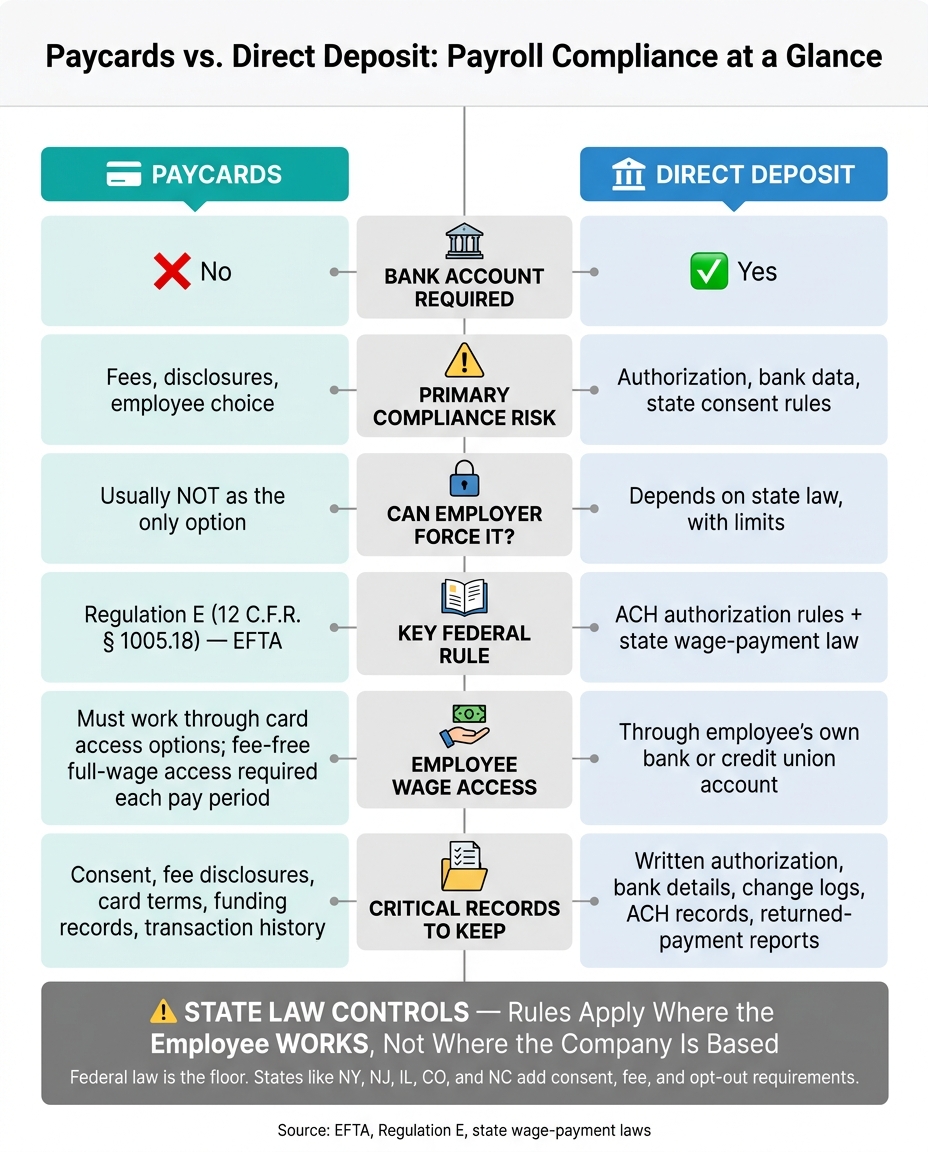
Paycards vs. Direct Deposit: Compliance Comparison Guide
How to Pay Unbanked Employees: Paycards Explained
sbb-itb-b1c1928
Paycards: federal rules, state limits, and employer tradeoffs
Building on the overview above, paycards tend to create the most risk around consent, fees, and vendor oversight. Payroll cards are governed by the Electronic Fund Transfer Act and its implementing rule, Regulation E (12 C.F.R. § 1005.18), when wages are loaded electronically on a recurring basis. The issuer handles disclosures and disputes, but the employer is still on the hook for lawful program design and making sure employees can access their pay.
Compliance requirements before enrolling employees
You cannot require a paycard unless you also offer another lawful payment method. Regulation E bars employers from requiring workers to receive wages through a payroll-card account picked by the employer unless another lawful payment method is also offered. In plain English, that usually means a real alternative like direct deposit to an employee-selected account or a paper check. The CFPB is clear on this point: employees do not have to accept an employer-offered payroll card.
Before enrollment, the issuer generally must give the Regulation E disclosures before the employee chooses the payroll-card account. That includes both a short-form disclosure and a long-form disclosure. Employers should work closely with the issuer to confirm that this happens on time and keep a record of the date, the alternative offered, and the employee's choice.
Employees also need fee-free access to their full wages each pay period. And that access has to work in the real world, not just sit in a policy document. Employers should also have written procedures for switching payment methods, resolving errors, and paying final wages.
State-law variation and fee-related risk
Federal law sets the baseline. States can go further, and many do. New York is one of the clearest examples. It requires employers to get written consent before paying wages by payroll debit card, and that consent must be received at least seven business days before the first card payment. New York also bars fees for services employees need to access wages in full, including application, loading, balance inquiries, account closure, and certain declined ATM transactions. On top of that, employers cannot pass any of their own payroll-card program costs to employees.
Fees matter in every state. If card charges push pay below minimum wage, the employer can end up with a wage violation. That's why employers should model net pay after recurring fees and transaction fees, then compare that result against federal, state, and local wage rules before launch and again whenever the fee schedule changes.
Paycard pros and cons for employers
This is the tradeoff. Paycards can help unbanked workers get paid electronically, but they also add more monitoring work for employers.
| Pros | Cons |
|---|---|
| Gives unbanked or underbanked employees electronic wage access without requiring a bank account. | Fee structures can create minimum-wage, unlawful-deduction, and employee-relations risk. |
| Reduces paper-check printing, distribution, and replacement. | Regulation E requires detailed disclosures before enrollment and ongoing account protections. |
| Automates recurring wage delivery through payroll processing. This often involves tools to generate payslips in bulk for the entire workforce. | State rules on consent, timing, fee limits, and free access vary by employee location and must be tracked carefully. |
| Offers a payment path for workers without conventional bank accounts. | Employers must actively monitor the card provider - fee changes, ATM availability, error handling, and service performance. |
| A compliant alternative payment method and a documented process for switching methods are still required. |
Direct deposit shifts the compliance burden from fee access to ACH authorization and state consent rules.
Direct deposit: ACH authorization, state restrictions, and employer tradeoffs
Direct deposit cuts down on paper, but it doesn't run on autopilot. Compared with paycards, the main compliance issue changes. Instead of focusing on fee limits, employers need to focus on authorization, employee consent, and state rules. That means getting employee approval, checking bank details, protecting ACH files, and following state law.
One point matters here: permission to pay electronically does not mean permission to force a specific bank choice. Federal law bars employers from making employment depend on opening an account at a particular financial institution. Employees must be allowed to pick the account where their wages go.
Required controls for setup and ongoing payroll
Start with a written or electronic authorization. It should identify the employee, the receiving account, and how the employee can revoke approval. Collect only the data you need: routing number, account number, account type, and deposit allocation. Then verify it.
Common ways to verify bank data include:
- A voided check
- A bank letter
- A prenote transaction
- An account-verification service
These steps help show that the deposit was approved and sent to the right place.
Account changes need extra care. A good process requires a second approver before any bank-account change moves into payroll. The system should also flag changes made close to the payroll cutoff. Employees should get the effective deposit date and plain instructions for reporting any change they didn't approve. And ACH files should move through encrypted, access-controlled channels, not through unencrypted email.
Returned or rejected deposits need a written exception process too. In practice, that means identifying the return code, contacting the employee through a verified channel, confirming corrected bank data, and recording the replacement payment. Final-pay deadlines can change by state and by the type of separation, so timing matters.
When mandatory direct deposit may be restricted
For multistate employers, the big question is simple: can direct deposit be required at all? The answer depends on the state.
| State | Key restriction |
|---|---|
| New York | Requires written employee consent; direct deposit is payment to an account at a bank chosen by the employee. |
| New Jersey | Requires written consent, prohibits obtaining consent through intimidation or as a condition of hiring or continued employment, and allows an employee to opt out with timely notice. |
| North Carolina | Permits direct deposit into an employee-selected federally insured institution; if direct deposit is the only option, employees must be able to choose their own financial institution. |
| Illinois | Must provide a form of payment readily convertible to cash without a personal bank account unless the employee voluntarily chooses direct deposit. |
| Colorado | Direct deposit must be voluntarily authorized, use an employee-selected federally insured institution, and be provided at no cost to the employee. |
For employers operating in more than one state, a state-by-state matrix helps keep this straight. It should track consent rules, opt-out rights, allowed backup payment methods, and bank-choice rules. That matrix also needs a review whenever an employee changes work location or a state updates its law.
Direct deposit pros and cons for employers
The core tradeoff is simple: less paper-check work, but tighter control over banking data and state-law compliance.
| Pros | Cons |
|---|---|
| Familiar access to wages through an employee's existing bank or credit union account. | Employees must have a usable account; unbanked workers may need a paper check or another alternative. |
| Reduces paper-check printing, mailing, and loss risk. | Incorrect routing or account numbers can delay wages or send funds to the wrong account. |
| Predictable payroll processing and easier reconciliation through electronic records. | Deposits may be rejected or returned due to closed accounts, incorrect data, or account restrictions. |
| Supports split deposits into multiple accounts and integrates with employee self-service tools. | Payroll systems and ACH transmissions require cybersecurity controls, access management, and vendor oversight. |
| Corrections, reversals, final pay, and off-cycle payments require documented exception procedures. |
Those pros and cons look different depending on the workforce. If a large share of employees are unbanked or underbanked, direct deposit can create friction fast. The same goes for employers that don't yet have strong controls for bank-data security across multiple states.
Paycards vs. direct deposit: compliance matrix
The matrix below shows which rules apply to each payment method. One point matters more than people think: the state rule that applies is based on where the employee works, not where the company is based.
Which requirements apply to paycards, direct deposit, both, or depend on state law
| Compliance issue | Paycards | Direct deposit | Classification |
|---|---|---|---|
| Mandatory participation | An employer can't force employees to use an employer-selected payroll card as the only option; state law may also require another option or extra notice. | Can be mandatory only when federal law allows the setup and state law permits it; employees generally must be allowed to choose the receiving institution or use another lawful option. | Depends on state law |
| Employee consent | Often needs written consent or another clear employee election, along with required disclosures. | Written authorization or another legally sufficient record is required or strongly advised; some states require express consent. | Depends on state law |
| Regulatory exposure | Regulation E, prepaid account disclosure rules, fee rules, and wage-payment law. | ACH authorization controls, wage-payment law, and state limits on mandatory direct deposit. | Both, with added paycard exposure |
| Fee disclosure | Disclose any fees before enrollment, including ATM, balance inquiry, replacement card, paper statement, inactivity, and out-of-network fees. | No matching prepaid-card disclosure rule; disclose any employee-paid charges when they apply. | Primarily paycards |
| Balance and transaction history | Give access to balance and transaction history through electronic, phone, or written options, including at least 60 days of history. | Employees receive account records from their bank; employers still keep payroll records. | Primarily paycards for account access; both for payroll records |
| Payment reversals and corrections | Replacement loads and card closures must be handled so earned wages are not wrongly withheld or made unavailable during an investigation. | Incorrect account details, rejected ACH entries, duplicate payments, overpayments, and unauthorized changes should be handled through a documented process; any recovery must follow wage-deduction rules and state-law limits. | Both |
| Onboarding | Give employees card terms, fee disclosures, access instructions, other options, and a record of employee choice before enrollment. | Collect authorization, account and routing details, verification, the start date, and a secure process for changes or cancellation. | Both |
| Payment-method changes | Verify all change requests and keep an audit trail. | Authenticate bank-account changes and use fraud controls before the next payroll run. | Both |
| Final pay | Check the state deadline and whether final wages can be loaded and accessed without an unlawful delay or fee. | Check the state deadline, ACH timing, and a backup lawful payment method. | Depends on state law |
| Recordkeeping | Keep employee elections, disclosures, fee schedules, payment confirmations, transaction histories, returned or reversed transactions, final-pay records, wage statements, and employee complaints or error investigations. | Keep authorization, verification steps, change history, payment confirmations, returned or reversed transactions, final-pay records, wage statements, settlement evidence, and employee complaints or error investigations. | Both |
How to choose based on your workforce and risk profile
Use the matrix to line up your workforce with the payment method that creates the lowest compliance risk.
Direct deposit is usually the easier path when most employees already have bank accounts and the employer operates in states that allow the setup. In practice, the work tends to focus on authorization, ACH controls, and bank-data security. For most payroll teams, that's familiar ground.
Paycards can help employees who don't use bank accounts, but they bring more disclosure and oversight work. That extra layer matters. Before launching a paycard program, review the issuer's short-form and long-form fee disclosures, make sure employees can get all of their wages without unreasonable fees, and confirm that Regulation E error-resolution protections are in place.
The goal is pretty simple: choose the lawful option that creates the least risk for your workforce and that your team can document and manage in every state where employees work.
Implementation checklist and conclusion
Payroll controls, recordkeeping, and payslip documentation
Use the matrix above as a working payroll checklist. Before you run payroll for the first time, pin down each employee’s work location and payroll jurisdiction. Then confirm which payment methods are allowed, what kind of consent is needed, any fee limits, and what backup option you’ll use if the main payment method fails.
For direct deposit, get written authorization, verify the bank account details, and require dual approval for any bank change. For paycards, provide the required fee disclosures, record that enrollment was voluntary, and make sure employees have a fee-free way to access their full wages.
Once enrollment is done, reconcile every payroll run against the approved payroll register and the funding records. That includes the ACH file or paycard funding record, deposit confirmation, and any returned-payment report. Track exceptions all the way through resolution, including:
- Rejected deposits
- Closed accounts
- Duplicate payments
- Card replacement requests
- Delayed access to funds
Keep the related records on file. Federal guidance generally requires core payroll records to be kept for at least 3 years and wage-calculation records for 2 years.
Pay statements should make the basics easy to follow: the pay period, payment date, gross wages, deductions, net wages, and any payment details needed to match the statement to the direct-deposit transaction or paycard funding record. CleverSlip supports PDF pay statement generation, email delivery, pay statement history, and employee self-service access to past statements. But it does not replace required consent workflows, paycard fee disclosures, ACH authorization controls, wage statements mandated by law, or state-specific legal review. Electronic delivery can work well when the system is secure, easy to access, and able to preserve records for the required retention period.
Payroll and HR teams should be trained on state-specific payment rules, accepted authorization methods, paycard disclosures and fee escalation, ACH fraud signals, identity checks, change controls, failed-payment steps, record retention, and complaint handling. It also makes sense to run a full compliance review at least once a year, and again any time you enter a new state, switch providers, or start seeing repeat complaints about fees or wage access.
Key takeaways for employers
The aim isn’t just to pay people on time. It’s to build a process you can document, check, and defend if someone asks questions later.
Paycards depend on consent, fee transparency, and access to wages. Direct deposit depends on authorization, bank-data security, and state-law limits.
Use a documented, state-specific process that keeps employee choice in place, records every authorization and disclosure, reconciles each payroll run, and is reviewed after legal changes or provider changes.
FAQs
Which states require written consent?
There is no federal U.S. law that requires written consent for electronic pay stubs. But state rules don't all line up.
Some states, including California, require employee consent before employers can use electronic pay stubs. Since these laws vary by state and can change over time, employers should check the rules in each state where their employees work.
Can employees switch between paycards and direct deposit later?
Yes, employees can usually switch payment methods, but the process depends on your company’s payroll rules and the state where the employee works.
When an employee wants to make a change, gather the banking details needed for direct deposit or set up the paycard. Tools like CleverSlip can help keep those updates accurate and audit-ready.
What should I do if a payment fails on payday?
If a payment fails on payday, check the cause right away. Common issues include incorrect direct deposit details or a payroll system error. Fix the problem fast.
Keep a clear audit trail of the payroll calculations and any changes you make. If payment is delayed, tell the affected employee what happened, what you’re doing to fix it, and when they can expect the money. Then send the corrected funds as soon as possible to help avoid disputes, penalties, and loss of trust.
Payroll, simplified
Create structured payslip PDFs in minutes.
Build country-specific payslip documents, deliver them instantly, and keep a searchable history for audits and employee requests.
Start free